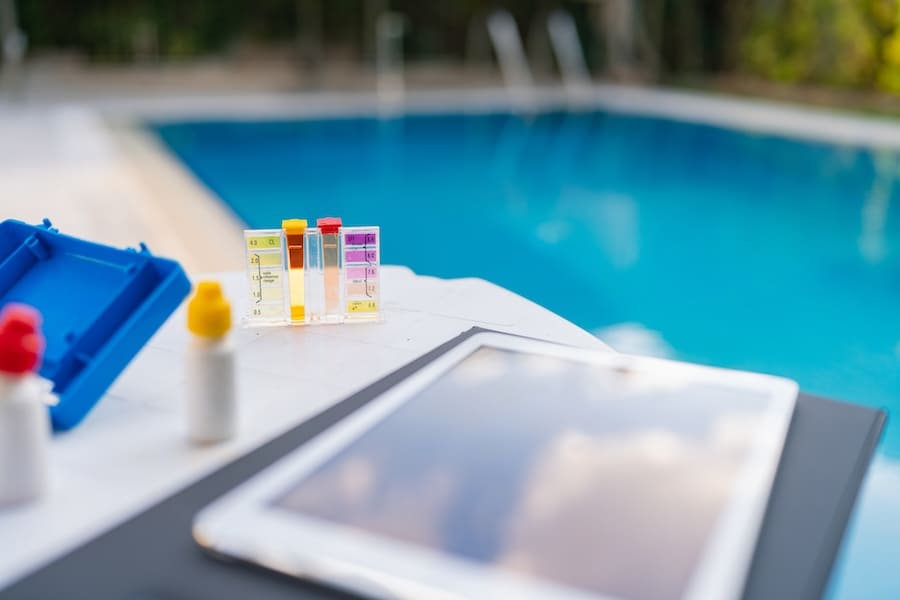
SAHI Pool Maintenance and Waterproofing has put together a guide to pool water testing, including some recommendations on how to test your pool water and common issues regarding pool water. As one of the fastest-growing pool service companies, we aim to take care of you and everything that has to do with your pool and spa. Enjoying your pool on a summer day should be a carefree and safe experience. Our guide to pool water testing can help you navigate unseen complications to ensure you and your family are safe while having a great time. If you have questions about pool water testing, don’t hesitate to reach out.
Why Should You Test Your Pool Water?
Water testing and pool inspection is a vital part of routine pool maintenance. Knowing how to and routinely checking your pool water brings you one step closer to making your pool a safe place to swim. Failing to check your pool water can lead to unregulated pH levels or unhealthy pool water damaging your pool equipment. Without proper testing, it can lead to a combination where the water and chlorine aren’t at the appropriate chemical levels, leading to the chlorine becoming unhealthy for the skin, eyes, and organs if swallowed. Thankfully, there are several ways to check your pool water, and they include the following:
Importance of Regular Pool Water Testing
It’s possible that you probably won’t change your pool water for multiple years at a time due to continuous filtration and disinfection, removing containments that keep the water enjoyable. That doesn’t necessarily keep your pool water balanced. A balanced pool has a proper pH level, total alkalinity, and calcium hardness. Having properly balanced pool water is important as untested and untreated pool water can accumulate harmful bacteria such as Salmonella, among other health concerns. Further, unbalanced pool water can lead to equipment damage, costing you more in repair or replacement parts. Here are our recommendations on how often to test your water for a balanced pool:
Free Chlorine – This chemical helps prevent bacteria and algae growth. We recommend testing one to two times a week, with an ideal range of one-to-four parts per million.
pH – An vital chemical that helps prevent swimmer discomfort while improving chlorine’s effectiveness and protecting your pool equipment. We also recommend that this be checked one to two times a week with an ideal range of 7.4-7.6.
Total Alkalinity – It’s designed to help prevent your pH levels from swinging in and out of range, and it’s recommended to be tested weekly, with an ideal range of 80-100 parts per million.
Calcium Hardness – Calcium hardness is there to help prevent surface damage such as scale and corrosion. Our team recommends that it be tested monthly with an ideal range of 200 to 400 parts per million.
Stabilizer – Finally, the stabilizer helps extend the life of chlorine by preventing chlorine burn-off from sunlight. Our recommendation is that it be tested two-to-three times per season with an ideal range of 30-50 parts per million.
Filter – Essential for maintaining crystal clear water, the filter removes debris and small particles from your pool. We recommend having one of our experts assess if your filter is appropriately sized and performing effectively. Upgrading the filter when needed ensures optimal filtration and enhances water clarity.